Showing posts with label Knights Templar. Show all posts

Wednesday, 16 November 2011

Robin Hood (2010) - A Review


I finally got around to watching the film about the legendary outlaw Robin Hood that was made in 2010 and famously starred Russell Crowe.  I say “finally” because my lovely other half hoards DVDs.  There’s no other word for it; she has shedloads of the buggers and we don’t have a shed.   The down side is that there are loads in the spaces that I think should be for books.  The up side is that she will get stuff that I would hold off from but that I might be interested in seeing, so there’s something when, if I’m feeling particularly tired, depressed or ill, to view.  Normally I don’t review films.  I prefer to either blog about more personal subjects (see my other blog Peripatetic Pyneosaurus for this) or stick to things that might be quite a bit more fact-based than anything coming out of Hollywood.  However, as with most of my interests, this movie has a little bit of strange stuff going on.
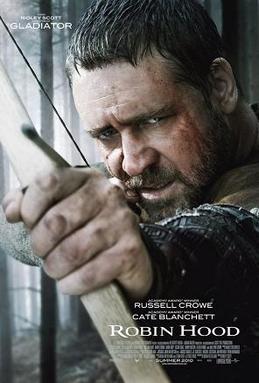
Robin Hood 2010 Wikipedia

Where to start?  The beginning?  That will have to do.  The legend that has been accepted in this day and age (for as with many things, it has changed through time) is that Robin is a Saxon nobleman who has fallen foul of King John and has taken to Sherwood Forest, waging a guerrilla war against the King’s local representative, the Sherriff of Nottingham.  This ends when King Richard 1st returns from the Crusades, pardons Robin, who marries Maid Marian and lives happily ever after.  What’s the first change?  The film is now centred on the First Baron’s War.  I have a shameful admission to make here.  I never did much history at school and, to my knowledge, never covered this very important event in Great British history, so full marks to Ridley Scott for drawing to my attention to this event when no-one else ever did.  In this alternative legend, Richard dies besieging a French castle (which we know he really did) and Robin Longstride, an archer in the King’s army, takes over the identity of the King’s friend and confidante Robert Loxley.  He returns to England and, with Loxley’s father’s consent, replaces Robert.  The northern barons are fed up with the way King John treats them so they back him into a corner to sign the Magna Carta (or at the very least some sort of predecessor charter).  Prince Louis of France has an agent in England who is conspiring to subjugate England to the French throne.  John is persuaded to join forces with the Barons, who by now include Robin, to repel an imminent French invasion.  Unbeknownst to Robin, Marian has disguised herself as a knight and has brought along some of the children that run wild in Sherwood Forest to fight alongside the English troops.  Robin wins the day; King John is livid that someone else attracts the approval of the Barons and, therefore, outlaws him.  Marian and Robin go to ground with the feral boys in Sherwood.  It is at this point that the film ends and the legend begins – according to Ridley Scott, anyway.

Where to carry on?  I, for one, really could not stomach the ‘Wild Boys’ in Sherwood Forest.  It smacked hugely of Peter Pan to me; a strange and completely inappropriate interpolation.  It was neither needed nor enhanced the story.  Possibly it was some kind of attempt to appeal to the kiddies, but it felt odd to say the least.  However, whilst browsing in search of some kind of sense to this, one theme at least caught my eye, of which more later.

The next issue to jump out at me was Robin’s father, who was a stonemason and espoused individual freedom and democracy.  He also seemed to be the author of the Magna Carta and was supported by the Barons.  It did not require the largest of mental leaps to link a mason with powerful support to a suggestion by the film’s makers of Freemasonry.  One American mason even heard Thomas Longstride (Robin’s father) speaking in a Scottish accent.  I replayed our copy and could not verify this, though.  The relevance of this is that some of the earliest documents relating to Freemasonry tell of lodges in Scotland, thus making it the probable cradle of Freemasonic movements all over the world.  Another point of note is that Thomas only practices one bit of stone-laying in the whole film.  The supposed departure from the stone mason’s guilds  to the freemasonry of today (more of this in yet another blog) is that there were, on the one hand, actual stone carving artisans and speculative masons on the other, who were gentry and certainly did not get their hands dirty touching stone and who were the antecedents of the Freemasons as opposed to what was, in effect, a mediæval trade union.  Thomas’s actions, or lack of them, seem to back this up.

Then there was the historically verifiable closeness of King Richard 1st to the Knights Templar who, whilst there is no evidence of a direct connection, have been claimed by some Freemasons as forebears.  There is even the example that Robert of Sablé, who had been a vassal of the Lionheart, became Grand Master at least partly by the recommendation of the king; such was his connection to the Order.

So, we have some quite singular stuff going on.  Robin took to the woods to pursue men’s freedom, which was a cause inherited from his Masonic father and backed up by the barons, plus back-handed references to King Richard and the Knights Templar.  So, Robin the Master Mason?  Are Ridley Scott and/or Russell Crowe on the square, then?  What also fascinates me is that no mainstream review that I have been able to find has mentioned any of this at all.  I do not claim a conspiracy, although it is interesting.  It is probably down to the fact that stuff like this is below the radar with most people.

To round things off, I personally rather liked the gritty, muddy “realism” and the lack of Lincoln Green and those little camp hats with feathers in, although I am a huge fan of the Errol Flynn film.  The action was riveting and the tale generally twisted, turned and moved on at a decent pace.  Those kids, though.  They got my back up.  One theory has it, though, that Robin was not also the second Freemason but that the children represented orphaned boys of World War 1.  In the USA, a Mason called Frank S Land noticed how many of these boys there were without mentors.  The organisation that he started was known as the Order of de Molay, after the last Grand Master of the Knights Templar, Jacques de Molay.  Thus, in leading the children, Robin fulfils another rôle of the Mason as a guiding light (such a strong Masonic theme that there are lodges named after it).  Sorry, kids, you were there for a reason all along!

Saturday, 11 September 2010

Rennes-le-Château - A New Angle?

This post is concerned with two themes that intertwine: Rennes-le-Château and The Holy Blood and the Holy Grail.  The former is a village in the department of the Aude in France and the latter is a book by Michael Baigent, Richard Leigh and Henry Lincoln.  I will be looking at both of these in greater detail in later posts, but, firstly, let us look over the information pertinent to these subjects.

 Andrew Gough has summed it up on his website when he says that there is little new to the mystery (and no-so-cottage industry) that is the enigma of Rennes-le-Château.  However, Josh Kroeker has discovered something about certain works of Nicolas Poussin that, whether it belongs to the aforementioned mystery or to another riddle, does seem to be something overlooked by anyone else.


Tour Magdala
from Wikipedia Site for Rennes-le-Château 


The story goes, very loosely, like this.  Bérenger Saunière was a poor priest to the aforementioned village from 1885 to 1909.  He was responsible for commissioning quite a few buildings around the hamlet, which sounds quite pleasant and civic-minded of him.  The start of the legend is here, though.  Where did he get the money?  Whilst it is true that he was guilty of simony (that is, the selling of masses) it did not bring in enough to pay for all of the fancy new edifices popping up.  These include a (gaudy) revamp of his ancient church, l’eglise Ste. Marie-Madeleine (the Church of St. Mary-Magdalene), the Villa Bethania and le Tour Magdala.  The Villa Bethania is a large house that Saunière doesn’t live but uses to entertain guests at extravagant parties.  The Tour Magdala, which is a stubby, square tower perched right on the edge of the cliff that Rennes-le-Château stands on, seems to be a combination of study, library and look-out post.  What a country priest would want with something like this is beyond most people – and most certainly beyond me.  It did not help that Saunière himself was a bit – well, stroppy.  He never got on well with authority and, in some ways, one cannot help but think that the Catholic Church, with a rigid, hierarchical system that would be the pride of any army, was not an obvious career choice for him.  In those days (come to think of it, even now) the area into which he was born and in which he worked was isolated and choices were few.  It is, however, the money that is the mystery.  The money that no-one can account for, quite literally.

This, then, is the enigma.  It helps to create mythology (or doesn’t if one is a seeker after the truth) that the region has had a romantic and bloody past.  The Romans, the Visigoths, the Knights Templar and the Cathars, an heretical sect that the Vatican waged war upon, all lived and died there at one time or another.  It is a land utterly steeped in inscrutability and history.  I had the huge luck to go there, and the combination of black mountains, surprisingly lush greenery, scorching sunshine, astonishingly ancient, isolated settlements with plaster falling off and streets so narrow you wonder what the point is in having them at all turns out to make you feel in your skin that the land is clutching secrets in the very rocks.  No wonder, then, that the merest sniff of something different is enough to inflate any happenings there into the most mind-blowing and blasphemous epic of the age.

We move onto that book.  The Holy Blood and the Holy Grail basically guesses that the priest of a tiny village found documents that hinted at a link to the first royal dynasty of France – the Merovingians.  So far, so fairly unremarkable.  After all, there’s nothing particularly astonishing about linking to royalty from your own land.  Well, as many of you probably know, the guess turned into a leap – a leap of faith, ironically enough, and the leap was that the Merovingians were descended from Jesus Christ after he married Mary Magdalene and had children.  As for this rarefied line of holy offspring; I went off and opened a spreadsheet.  I assumed that for one couple, there would be two couples in the next generation, and so on.  I assumed that growth would be exponential (two, four, eight, sixteen… each generation doubles).  I also assumed that, unlike in the modern West, each generation could be expected to have children at the average age of fifteen.  By the time I had finished, the final sum looked like the kind of figure that astronomers work with.  It was (drum roll, please maestro) 1.09E+40.  If I remember aright, it is a one with forty decimal places after the dot.  Billions, in other words – the other words being squillions and such.  Not a particularly exclusive club then.  Now, my methods were quite a brief and slapdash approach to such statistics but, even including complex algorithms for variations in location, weather and age, we’re almost certainly looking at a million or so souls, possibly with the genes of God, walking our Earth today.  Nobody tell Richard Dawkins.

Okay, we have a very-well-off priest in the back of beyond holding loud parties in posh, new houses that he never lived in and the root of his wealth could be that he was blackmailing his employer with the information that children of their God were sharing the planet with them and, presumably, making the Catholic churches’ claim to be the one, reliable source on this planet of what God wants a bit shaky.  Where I fall out with this is that I am of the school that the so-called “historical” Jesus might not even have existed.  Even St. Paul seems to have treated Jesus as a purely incorporeal god similar to the other deities of the day.

What I will say in favour of The Holy Blood, though, is that it started many people on the road to thinking about the church, the Bible and claims related to them.  Rather than just accepting the story of Christ as it is taught by the Church, folk started to question, which, even by itself is a good thing in my opinion.  When I was much younger, I read this book when it first came out.  It made me look for conundra amongst the mundane and enlivened my life considerably.  Nowadays, especially in the wider world, the arcane lurks to surprise and, hopefully on occasion, delight us.

Thursday, 11 March 2010

Robin Hood - More Than an Outlaw?

Robin Hood.  I have mentioned elsewhere that I have been fascinated by this swashbuckling character since childhood.  It may just be that there were not many mediaeval figures to feature in stories when I was a mere stripling, but my interest has held fast over the years.  There has been much scholarly debate whether he actually existed, or was an exercise in mythological folk tales and such.

I have also found the knight-errant stories absorbing, too.  Along with plastic cowboys and the like I also had toy knights - namely crusaders.  Their armour (unbeknownst to me at the time) was also fairly accurate for that period.  When, later on in life, I learned about the Knights Templar (the warrior monks of Jerusalem) I became even more engrossed in the period of time surrounding the Crusades.

I have been a regular reader of a magazine called the Fortean Times for at least fifteen years now.  Named after Charles Fort, an American who collected reports of strange phenomena and later wrote several books on the subject, it has been a constant delight and eye-opener.  Imagine, therefore, my surprise and delight when I found both subjects covered in one article!  To try and summarise; the Templars were outlawed by the Pope at the time and some of them may have hidden in the woods.  They were very skilled in feats of arms, and so one of these bands could have been led by the character we came to know as Robin Hood.  The chap who wrote the article, John Paul Davis, has written a book - "The Unknown Templar" - on this very theme.  I fully intend to get my hands on a copy.  Here is a link to their site.  Try registering and typing "Robin Hood" into their Search.  See what you think.